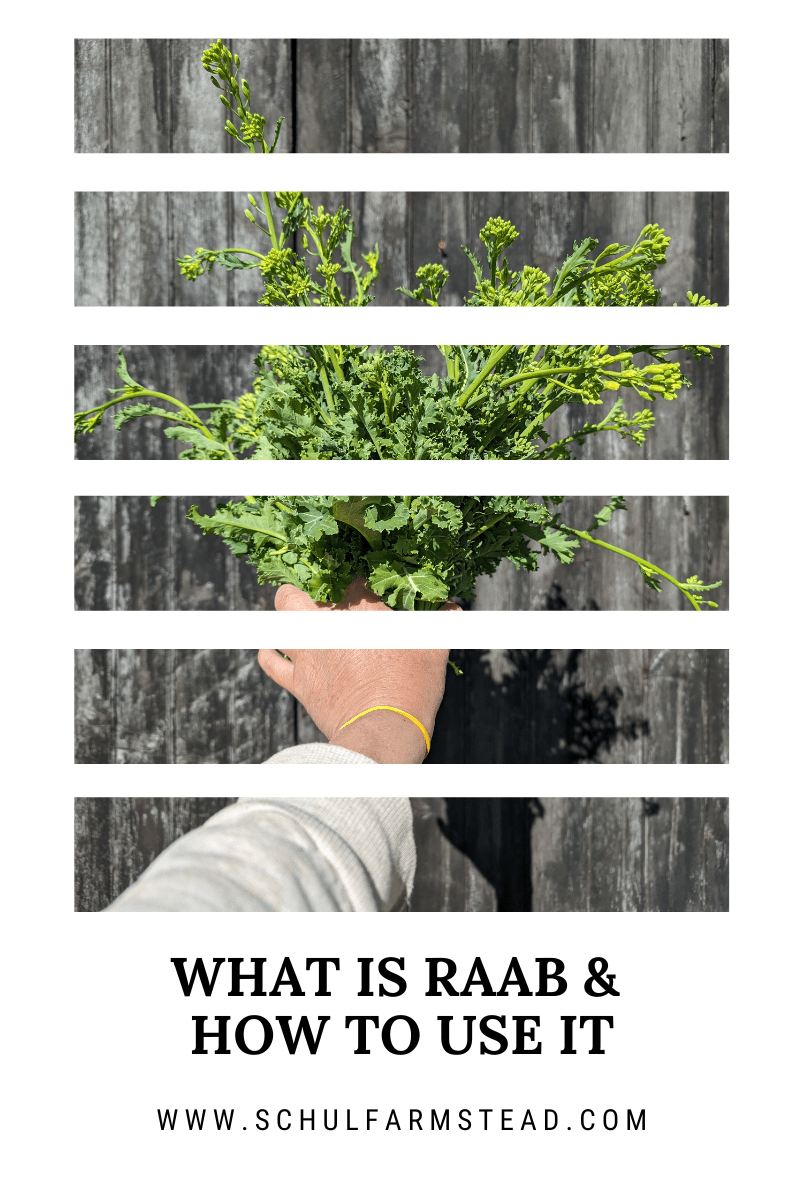
The flush of spring brings “raab” or “rabe” to the farmer’s market.
Maybe you’ve seen this weird looking green at the farmer’s market table and thought about trying it.
But then talked yourself out of it…
It did say “Kale Rabe” or “Arugula Raab” on the sign…and it kind of looked like kale, but what is it?!
You’ve never seen it at the grocery store…is this some kind of hybrid vegetable?
What is Raab & Rabe?
Often confused with broccoli rabe or rapini, raab or rabe (both spellings are correct) is a tender spring delicacy.
Like blooming spring ephemerals (tulips, daffodil, crocus) who quickly bloom and then disappear, raab/rabe is a vegetable ephemeral that quickly emerges in the spring, but isn’t found again until the following year.
Raab/rabe is the spring flowering of any brassica (aka: cabbage family) that survived winter.
You often find arugula raab, kale raab, tatsoi raab at the farmer’s market— all members of the hardy brassica (cabbage) family.
It’s a delicacy that only finds its way to farmer’s markets, so if you see it, snatch it up!
After I explain to folks at the farmer’s market what raab/rabe is, they are intrigued, but then politely tell me — “I’ll try that next week, maybe.”
Because I never want to come off as pushy and sale-sy, I usually don’t say what I want to…“Like the daffodils, tulips, and crocus blooming in your yard…raab/rabe won’t be at the farmer’s market next week. If you want to try it, you need to buy it this week.”
Once it’s cut from the field, it’s gone.
Unlike kale, arugula, cabbage, and other brassica family greens, raab/rabe is a rarity — here today, gone tomorrow.

Why You Never See it at the Grocery Store
Let’s be honest — the grocery store truly only carries a few types of produce or vegetable items.
It carries items that can be loaded on a truck and transported 1,500 miles and still arrive looking…decent, before being placed in misting, cooling areas of the produce section of your grocery store.
It doesn’t have 16 different kinds of winter squash.
It has cardboard tomatoes.
And 90% of the root vegetables are missing their (very natural) green leaves.
You’ve never seen raab/rabe because it doesn’t transport well.
Even caring for it the way I do other greens on the farm – harvesting in the cool of the morning, dunking in a quick cool bath of water, drip drying, and storing in my walk-in cooler before bringing it to market the next morning – by the time 1pm on Saturday rolls around, the raab/rabe is looking a little peaked.
That’s why IMO farmer’s markets are superior to grocery stores.
The produce, even the odd things like raab/rabe is fresh, fresh, fresh and packed full of so many more vitamins and minerals.
Raab/rabe is a tender green and it would not take the beating in transport that produce is subjected to when it travels across the country.
How to Use Raab
So I’ve convinced you to give this spring ephemeral green a try.
You placed it in your farmer’s market reusable bag.
Now what?
First know that all of it is edible and should be used in your dish — the leaves, stems, and florets (the little tiny flowers or flower buds).
Unlike their summer and fall counterparts, raab/rabe should be a cooked.
Ough, not what you were hoping I’d say?! Not a fan of cooked greens. Keep reading…
When you get it home, place its stems in a glass of cold water and put it the fridge, yes, like a bouquet. If it’s looking a little tired, this will help revive it.
Then use it in your meal within the next day.
Or, you can always wash, dry, chop, and quickly freeze it in a freezer safe bag or container to be used later. Since it’s going to be cooked, freezing it won’t hurt it.
>>> Related: How to Incorporate More Greens Into Your Meals

Suggested Ways to Eat Raab
If you like cooked greens and have lots of recipes, feel free to skip this part.
But if you don’t have lots of cooked greens experience under your belt here are 4 ways to use it:
- chop and add to a soup
- chop and add to a stir fry
- chop and add to pasta or risotto
- chop and add it to homemade pizza
Tomato-Braised Lentils with Raab Recipe
This recipe will take about 45 minutes to make.
Ingredients:
- 4 tablespoons extra-virgin olive oil, divided
- 1 medium onion (or shallots), finely chopped
- 1 clove garlic, minced
- 1 1/2 cups green French lentils
- 1 tablespoon tomato paste
- 3 cups stock (chicken or vegetable), plus some extra if needed
- 1 large bunch (or 2 small bunches) raab
- 1 clove garlic, sliced
- 1 large tomato, chopped
- 1/2 cup heavy cream
- 1 to 2 tablespoons butter
- Handful fresh basil leaves, roughly torn
- Salt and pepper to taste
Directions:
- Heat two tablespoons of the olive oil in a heavy-bottomed saucepan. Sweat the onions over low heat for about 8 minutes until translucent, seasoning with salt and pepper. Add the minced garlic and cook another minute. Add the lentils, tomato paste and a splash of the stock. Increase heat to medium and stir occasionally until stock has been absorbed. Continue adding stock and stirring occasionally until the lentils are just tender, about 30 minutes.
- Meanwhile, bring a separate pot of water to boil and prepare a large ice bath. Drop the raab in the boiling water and cook for 1 to 2 minutes. Remove with tongs and immediately place into ice bath until cool. Drain and pat dry. In a separate pan or skillet, heat the remaining 2 tablespoons of olive oil. Add the sliced garlic clove and the raab. Season with salt and pepper and sauté for 2 to 3 minutes.
- Add the chopped tomato to the lentils and cook for 2 to 3 minutes. Add the cream and butter, and taste for seasoning when warm. Stir in the basil leaves, then serve immediately with the sautéed raab on top.
Get to know more unusual vegetables that you see at the farmer’s market…
What are Microgreens & How to Use Them
 Schul Farmstead
2 thoughts on “What is Raab & How to Use it”