As someone who has a strong appreciation for gifts that are “natural”, zero waste, or plastic-free, I’m often gifted flower bouquets on special occasions.
It’s the sweetest thing ever to be thought of & to have folks who want to show their love for me.
But often their gifts are flower bouquets bought at Wegmans or Tops, our local grocery stores.
Which means they are actually giving me a gift that is probably one of the most unsustainable, least earth-friendly, and chemically-covered gifts possible.
Why Grocery Store Flowers are So Bad
First, it’s not the grocery store itself. If you buy flowers from a local florist, 1800-Flowers, Costco, Wal-Mart, or even Trader Joes you are going to be running into the same issues.
80% of these flowers are grown overseas.
They’re COVERED in chemical pesticides, herbicides, and fungicides (far out pacing the amounts on food). Grown by exploited workers who lack any protections that American labor laws and OSHA provide.
And then they are packed cargo jets, sprayed with more chemicals to kill any possible bugs or pathogens that could arrive when imported, and flown to the United States.
Then they’re trucked all over the United States in semi-trucks.
Simply put: flowers at the grocery store are covered in harmful chemicals, are the result of worker exploitation, & a carry massive carbon footprint.
They’re like the H&M, Zara, or Shein of agricultural products.
How Did We Get Here?
Until the 1990s, flowers sold in the United States were mostly grown domestically.
It was not until the federal government began to implement trade agreements, providing subsidies and support to foreign governments to plant flower fields instead of trading in illicit activities, such as drug manufacturing and trade that the ratio of imported vs. homegrown flowers flipped.
That’s why you’ll often find flower bouquets whose labels indicate they were imported from Columbia and Ecuador.
The problem is that these decisions created a scenario where imported flowers and foliage were now able to be sold into the U.S. at lower prices than our own homegrown farms could produce and sell at.
In the 1980s, a dozen American-grown roses cost almost $150, which was why they were the symbol of luxury. But what does a dozen imported roses cost now? $30?
The competition from imports left most American growers struggling to compete – which is why many of those farms disappeared. It’s hard to compete when the imports are paying their workers $1/day for 12-14 shifts.
And to be clear – I’m not saying American flower farms weren’t growing using pesticides, herbicides, or fungicides. Like today, especially on large farms, it’s likely that they were sprayed with lots of chemicals, just like our conventionally grown vegetables.
But it does mean they were grown using chemicals allowed for use in American agriculture and following our labor standards (mostly – labor in U.S. agriculture is a big issue, far bigger than this blog post).
Those cheap, $10 flowers from the grocery store come with a lot of nasty baggage.
And to quote my friend Fran, a local, organic flower grower & florist at Heirloom Soul Florals:
When you’re aware of these issues, and you continue to buy these flowers, you support the chemical companies with your dollars. By buying these flowers, you say: Yes, I’m okay with all the natural resources that were wasted to get these flowers into my home. Your money says: Yes, I support this industry and I want this to continue to be the norm for flowers in my grocery store. Whether or not you mean it, your money is supporting an unsustainable system that is causing great harm to humans and our planet. – Fran Parrish
Why Buying Local & Organic Flowers Matters
I think it’s easy to quickly identify the benefits for buying local goods – whether that’s flowers, vegetables, bath products, or whatever.
When you buy locally grown/produced items & you shop with a local small business:
- 60 cents of every dollar is returned to the local economy
- the carbon footprint of that product is significantly minimized
- there is a reinvestment in the community through the labor force or business community contributions
The campaigns to buy local are not new.
Buying organic, especially when it comes to flowers, however might not be something you ever took into consideration.
When you buy organic – whether that means the flowers are certified organic, certified naturally grown, labeled as pesticide-free, or another “label” from the farmer uses – you can be confident that the flowers are free of harmful, earth-damaging chemicals.
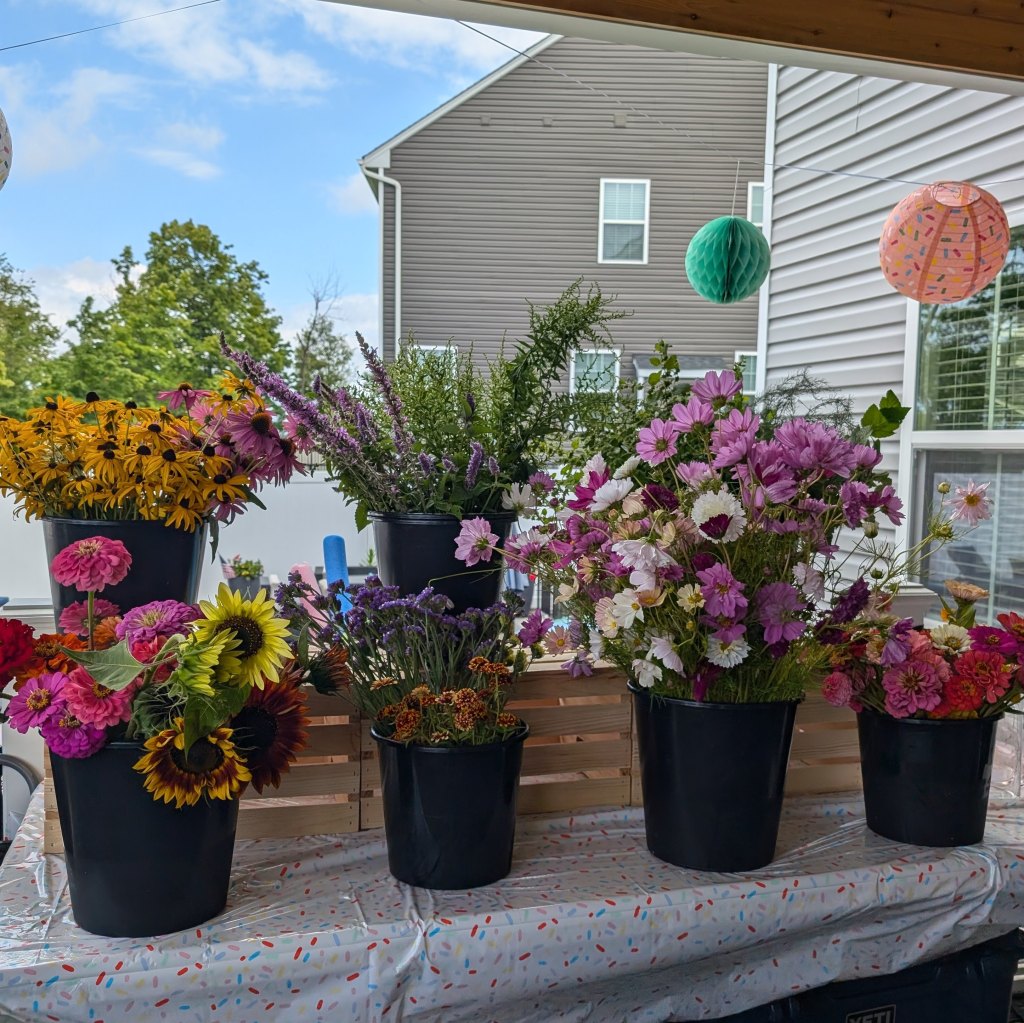
As both a vegetable and flower farmer, I work hard to grow flower blooms that are beautiful and spray-free because I believe in doing work that is beneficial for human, plant, animal, insect, and microbe creatures on this earth.
Except for voles. They suck. They are only good as birds of prey food.
When I refuse to spray pesticides, even those labeled as “organic” like neem oil, I am protecting pollinators and beneficial insects as I grow a colorful bed of zinnia flowers.
When I make the choice to battle weeds with hand tools, instead of an herbicide, like Roundup, I’m protecting the soil microbes that I can’t see, and the worms and grubs (yea, the ones that the voles love – you’re welcome voles).
By choosing to monitor my patches of black eyed susans, spacing them to mitigate the spread of plant-killing fungus, I’m making a choice to not spray with fungicides.
Growing organically, without the use of synthetic pesticides, herbicides, and fungicides is not only a business or personal choice I’ve made. It’s a choice I’ve made because it’s critical that we care for the earth in significant ways.
I know that so many folks, like myself, have earth- & human-centered values that show up in their lives when they buy organic foods, volunteer in a shoreline clean up, bring a reusable bag, and donate to the food pantry…
Why should they have to compromise their values when they buy a bouquet of lovely flowers?
They shouldn’t have to.
That’s why buying from local, organic flower farmers is important.

Find & Buy from Local, Organic Flower Farmers
How do you find a flower farm that is local & organic? These are two websites that you can use to search what’s nearby.
You can also shop your local farmer’s market. Again, you might have to ask the farmer directly at the vendor table if their flowers are organic, or spray-free, but this is a way to find local growers.

How to Buy Local, Organic Flowers from Schul Farmstead
If you are in Western New York and want to support a local, organic flower farmer, here are some options:
- Visit me at the Lewiston Artisan Farmers Market on Saturdays, 9am-1pm in the village of Lewiston from April to December
- Buy tickets to one of my floral classes
- If you’re looking for flowers for a DIY wedding, shower or would like florist-made quality bouquets for your wedding, please check out my friend Fran at Heirloom Soul Florals
Remember, like other buying choices you make in your day-to-day, voting with your dollars and choosing to buy locally-grown, organic flowers matters.
Keep Reading…
 Schul Farmstead
One thought on “The Hidden Costs of Buying Grocery Store Flowers”