
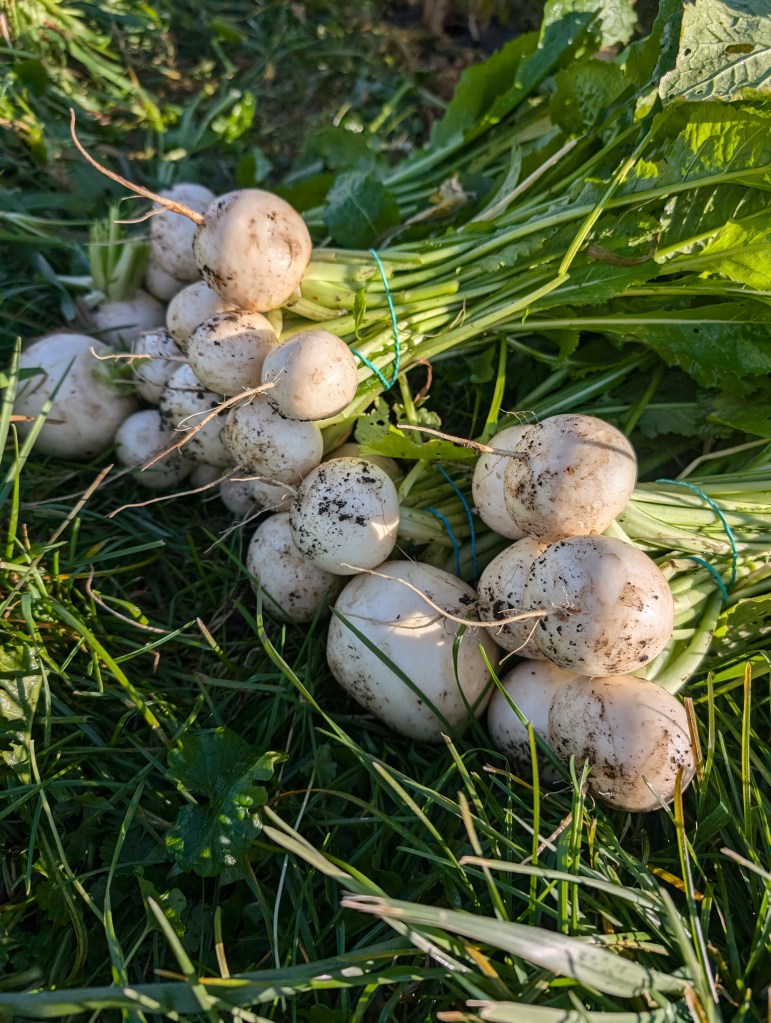
Something I never saw until I started growing in a local community garden was a salad turnip.
It was white, round, and tender with the greens sticking out of it like a radish or beet…and I didn’t know what to do with it or when to harvest it.
A few of them stayed in the ground all summer, their tops bolting and sending a stalk of flower buds after the root grew to the size of a softball.
That was 2012 and since I’ve learned and grown thousands of tender salad turnips.
In this post I’ll share with you what salad turnips are, tips for eating them, how to store them, and when you can expect them at the farmer’s market.
What are Salad Turnips?
Like many vegetables, salad turnips are called many things, including Hakurei Turnips and Japanese Turnips.
Traditionally they have been found in Japanese cooking following World War II when they were developed as a way to quickly feed people during food shortages (they only grow about 40 days).
Like many Asian vegetables, they are making their way to American plates by way of foodies, community supported agriculture shares, and small-scale farms (like mine!) at farmer’s markets.
Salad Turnips are a white, sweet, mild, crunchy, tender turnip that stands in contrast with it’s more infamous fall purple-top turnip cousin.
Unlike fall turnips, Salad Turnips are sweet and buttery.
They’re actually kind of more like a spring radish.
And Salad Turnips are best when they are about the size of a golf ball (not softball as described above).
How to Eat Salad Turnips
Salad Turnips can be eaten raw or cooked.
When they are cooked they are sweet and buttery.
Peeling is not necessary.
And their greens can be eaten too – they have a mild sweetness.
How to Store Salad Turnips
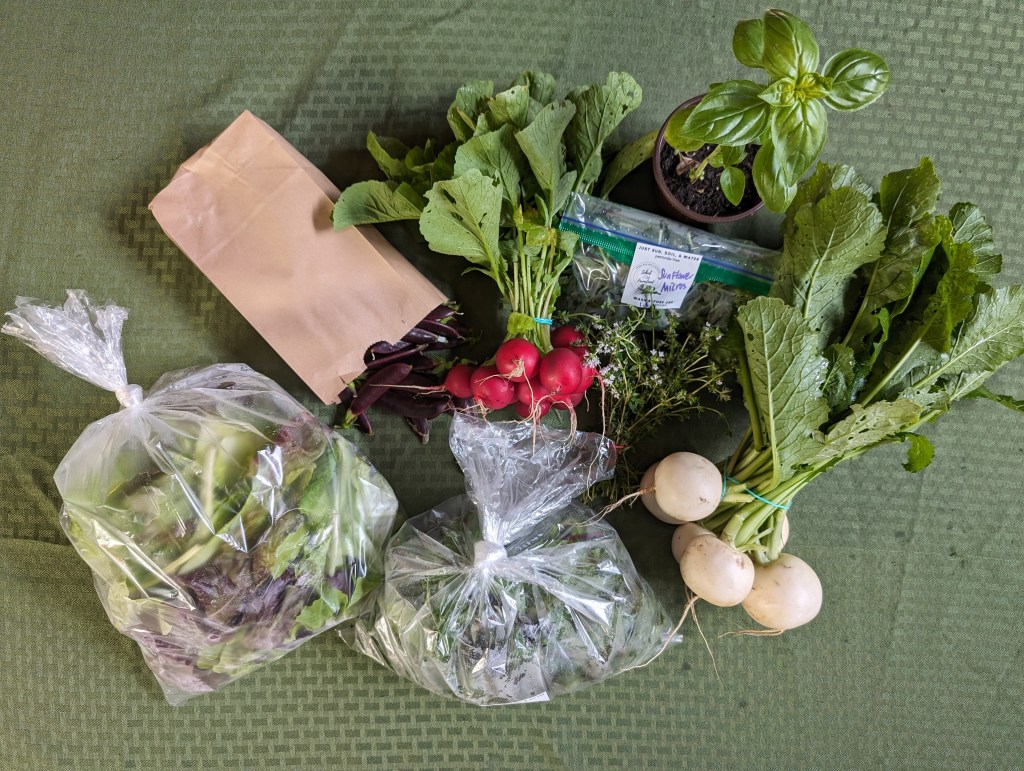
When you purchase Salad Turnips at the farmer’s market, you’ll likely find them still attached to their greens — this helps the farmer convey their freshness because the greens start to wilt after a day or so when they are attached to the root.
When you arrive home with your beautiful bunch, chop the greens from the root and store in the fridge.
They will last about a week, especially if stored upright in a cup of water in the fridge (like a flower bouquet).
You can quickly wash, dry, chop & freeze to use in soups or any recipe that calls for cooked greens (pastas, rice dishes, etc.)
The roots can be stored in your crisper drawer on the vegetable setting for about a month. As long as the roots are still firm, you are in good shape.
When Salad Turnips are In-Season
I like to include this part whenever I share information about a vegetable that is less well-known.
So many of us are used to finding whatever we want, whenever we want when we go to the grocery store, whether it’s actually in-season for the region you live in or not.
And even if you attend farmer’s markets, depending on the market’s rules, what you think is a farm vending their “fresh” produce is actually someone who purchases produce wholesale at the produce market, after its’ been shipped from across the country or outside the country. (Many of these vendors have words like “produce”, “vegetables” or “fresh” in their name vs. “farm”)
For Western New York, (zone 6) Salad Turnips are available two times a year:
- spring, May-June (potentially April if a farm has them growing in a protected high tunnel)
- fall, September-October (potentially November if a farm has them growing in a protected high tunnel)
Braised Salad Turnips with Balsamic Glaze
Ingredients:
- 2-3 T butter
- 1 bunch salad turnips, greens removed and saved for another use, roots trimmed and quartered or cut into bite sized chunks depending on size
- 2-3 T water
- 2-3 T balsamic vinegar
- 1 T sugar or 2 teaspoons maple syrup
- salt and pepper to taste
- minced fresh herb like parsley, scallions, etc. (optional)
Directions:
- Melt butter in pan and add turnips to coat. Add water and bring to simmer.
- Reduce heat to maintain slow simmer, cover and cook until tender, about 7-10 minutes.
- Uncover pan and add vinegar, sugar, salt, pepper. Increase heat to medium-high while stirring frequently until sauce starts to form a glaze on the turnips.
Curious about other unique, pesticide-free veggies that we grow on our farm? Keep reading…
How to Love & Enjoy Root Veggies
 Schul Farmstead
3 thoughts on “What are Salad Turnips & How to Eat Them”