
On my farm I grow with love & intention.
Love for the earth, love for the soil, and obviously love for the veggies, herbs, and flowers.
I care for the farm with intention – attention to detail in crop rotation, intentionally selecting crop varieties, and a deep intention to be a responsible steward of the land and environment.
With Earth Day around the corner (April 22), I wanted to highlight 6 earth-friendly things about my farm.
No-Till / Low-Till Permanent Beds
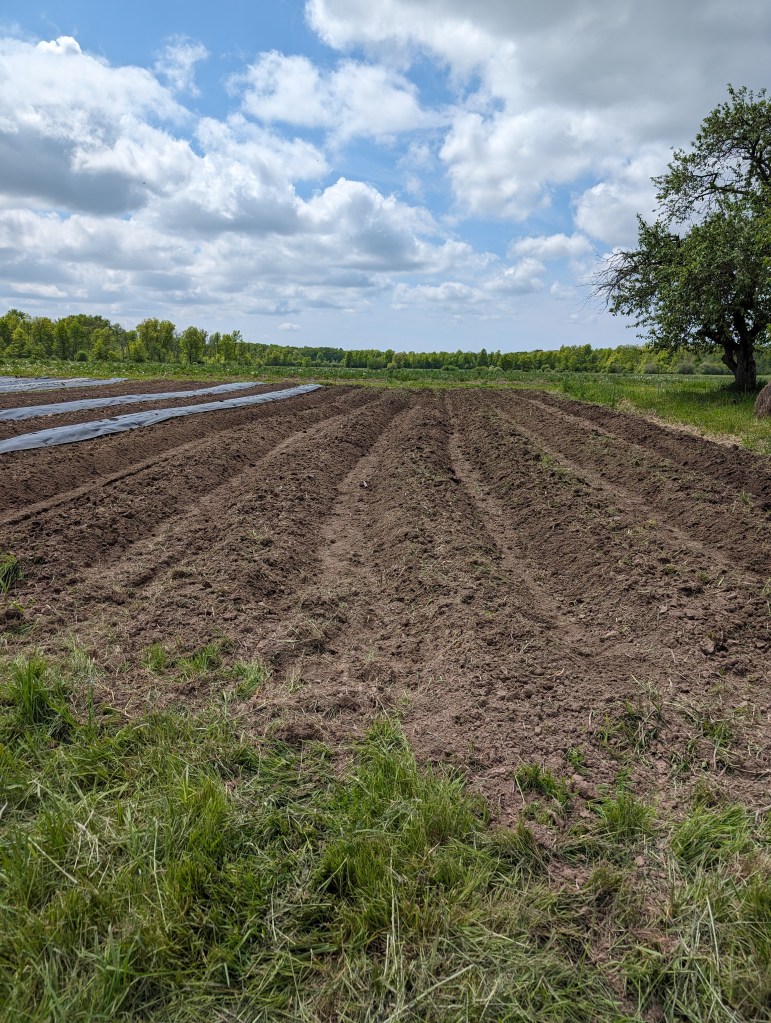
My farm operates as a no-till/low till farm.
This means, instead of tilling or turning over the first 6-10 inches of soil before planting every spring, I only work over the first 1-3 inches of the soil on beds that I’m planting.
This keeps the soil structure intact, along with its microbes and nutrients, because the soil is less disturbed. The soil microbiome remains healthy and microorganisms, fungi, and bacteria feed off organic matter.
Minimal and no-till practices on small farms like mine, help to sequester carbon, rather than releasing it into the atmosphere, which is common in conventional large-scale farming.
The release of carbon into the atmosphere from soil tillage is a significant contributor to climate change.
In return for this care, my soil is better able to absorb rainwater and increase irrigation efficiency.
Less soil, and its nutrients, are washed away during large rain events, so I can grow more nutrient-dense vegetables for my Western New York farmers market customers.
No-Sprays
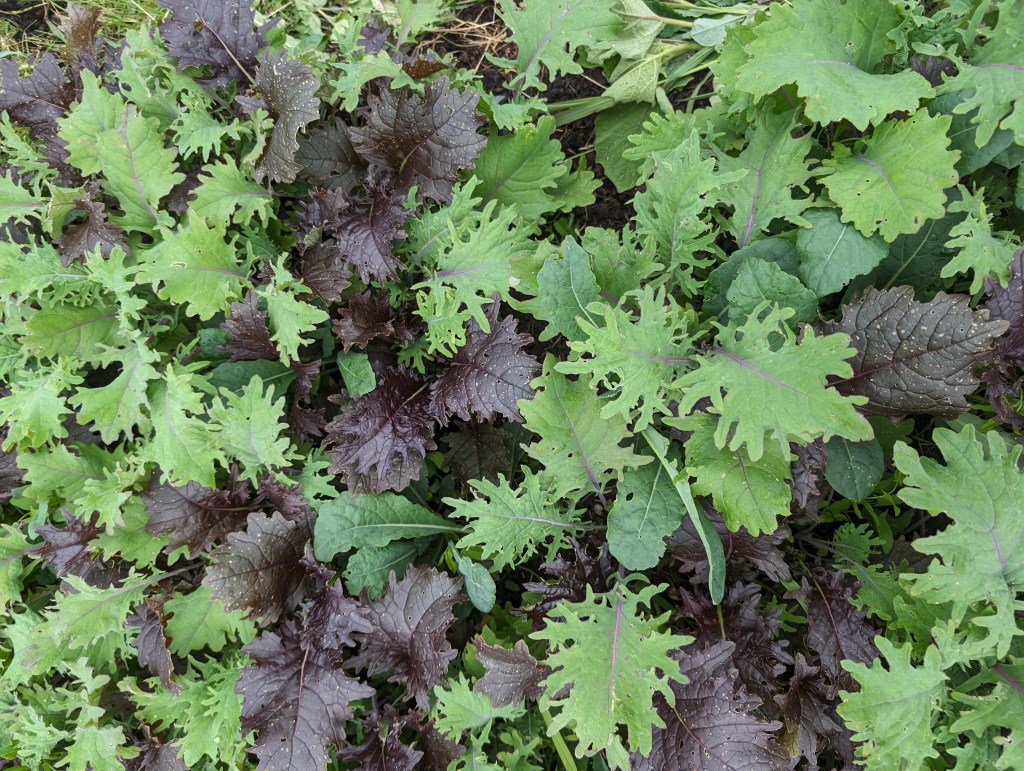
I don’t spray any synthetic or plant-based pesticides, herbicides, or fungicides on my veggies, herbs, flowers, or soil.
ZERO.
If I did, I’d have a much easier time growing pest-attracting crops, like cucumbers & squash.
If I did, I’d spend less time on the very time-consuming task of weeding.
I didn’t change my career and life to spray a bunch of chemicals on people’s food.
I changed my career because I wanted to grow food and flowers for people that wouldn’t harm the soil, insects, microbes, people’s health, and the planet in the process.
I wanted to grow food that people could enjoy without having to worry about what potentially harmful chemicals they could be ingesting.
So that’s what I do – no sprays included.
Insect & Creature Habitats
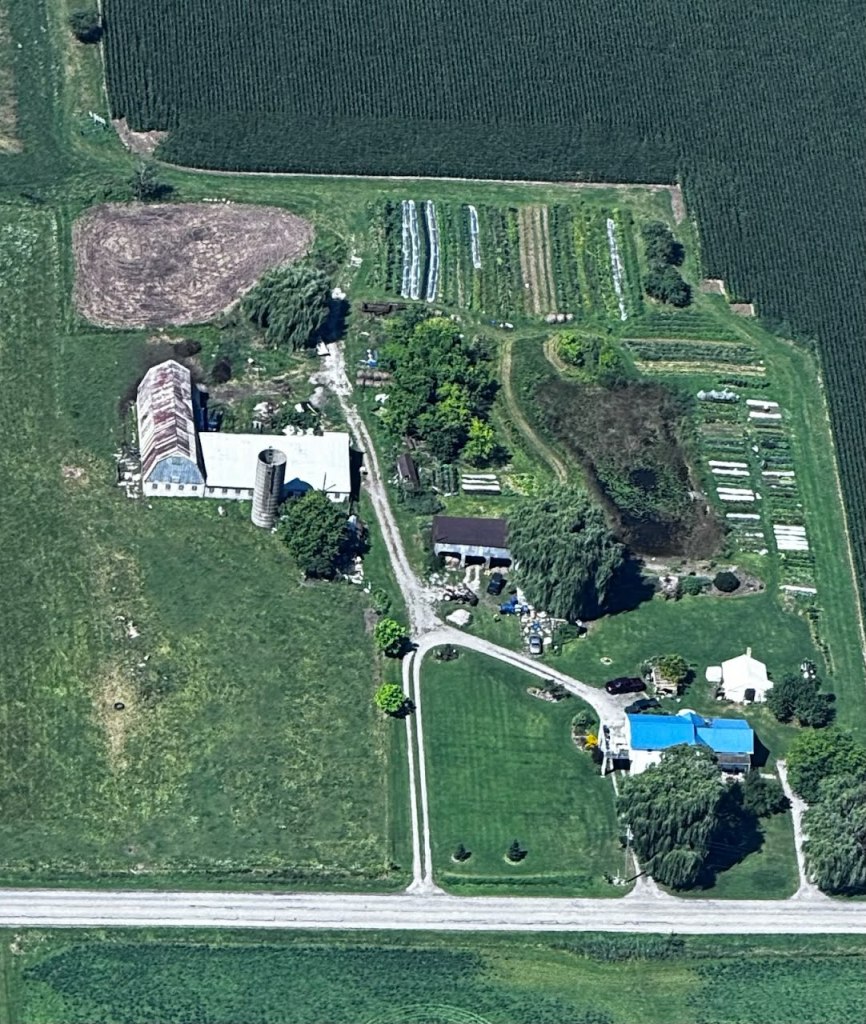
To me, the farm is not just the rows of permanent beds in my fields filled with vegetables, herbs, and flowers.
The farm is an eco-system and it’s my responsibility to create habitats to support living creatures as I use other areas on the farm to grow my crops for CSA and farmers market customers.
Surrounding my growing fields, the ground is covered in native perennial flowers, like goldenrod and milkweed, and cover crops, like hairy vetch, that attract and create a home for the life cycles of pollinators and beneficial insects.
These perennials have long root systems that retain water, improve soil’s porosity, sequester and store more carbon, and improve soil health.
And I don’t have to replant or reseed them every year.
I include trees, shrubs, rock piles, and a water source (our 150ft pond) to create a welcoming environment for birds, dragonflies, bats, and snakes.
Including the planting of Native American plum trees in 2025 which will (hopefully) lure and create a welcome home for birds to eat the cucumber beetles that try to ravage my cucumber, zucchini, and squash crops each summer.
I also work to lure pollinators and beneficial insects to my crops beds through the use of companion planting and interplanting flowers and herbs that attract these insects.
In my never-ending quest to reduce the vole (field mouse) population on the farm, my dad built and erected owl houses to provide a space for them to nest in the spring.
We’re also planning to erect some large posts around the perimeter of the growing fields out of ash trees from our woods that succumbed to ash borer infestations to create more perch areas for hawks and other birds of prey to keep the vole population in check.

Keeping Soil Covered
I sow cover crop on many of our permanent, no-till beds throughout late summer and fall to build nutrients back up (like nitrogen) and add organic matter into the growing soil.
Sowing cover crops also prevents the soil from eroding with the winter snows and spring rains before they’re ready to be planted in.
I choose cover crop seeds like oats and winter peas, that are killed by frosts and left to decompose under the winter snow and the warmth of the early spring.
Cover cropping was commonly used on farms until the early 1900s, when industrial chemicals for fertilizing, weed, and pest control (herbicides & pesticides) became broadly available and economically practical.
The broad application of synthetic chemical compounds stresses the soil’s ability to retain moisture and decreases beneficial organisms found within the soil.
By being spray-free and using cover crops, my goal is to support and build soil microbial life so I can provide a good crop yield for customers for years to come.
Since I continue harvesting cold-hardy crops like lettuce, spinach, and kale well beyond the first frosts of mid-October, beds that are harvested afterwards aren’t able to have fall-sown cover crops planted into them.
Instead, I cover them in hay or shredded leaves to protect the soil from eroding.
Both methods provide food and protection for soil microbes.
In spring, I incorporate cover crops or mulch into the beds, which adds organic matter.

Integrated Pest Management
Integrated Pest Management is a fancy-sounding tool to evaluate and make decisions on the farm to control pest infestations, whether from bugs or mammals.
The biggest pests on the farm are cabbage worms/moths & cucumber beetles.
We also have a lot of flea beetles in the spring, but I do little to mitigate them since their damage is purely cosmetic on the brassica crops like kale and arugula.
Cabbage worms/moths are the little white “butterflies” or moths that you likely see fluttering about your yard from time to time.
They lay eggs on the leaves of crops in the cabbage family (kale, arugula, collards, cabbage, etc.) that then turn into catepillars.
When they’ve hatched the caterpillars chomp holes in the leaves, sometimes quickly decimating an entire plant within a few days, depending on how many eggs hatched and made it into the catepillar stage.
When they’ve gotten to their mature stage, they turn into a cocoon and emerge as the white moths.
To manage the cabbage worms I check the brassica plants roughly two times a week to squish eggs, worms, or cocoon.
Typically this method of management (manual killings) is effective with this pest, but depending on the level of infestation it can be weeks before the plant rebounds and produces more leaves.
As part of the integrated pest management practice, I could choose to spray a plant-based pesticide to kill the pest.
However, in every instance in my 4 years of farming, using this manual management method, I’ve been able to significantly lower the pest pressure and the crop has rebounded.
Knock on wood this continues.
Less Plastic at the Market
This last earth-friendly thing I do is less about what’s done on farm and more about how I present my products to my customers.
I fully acknowledge that the bags I use for my salad mixes, microgreens, organic sourdough granola, and organic herbal teas are made with plastic. I haven’t identified a plant-based, compostable bag that 1) keeps the quality of the product in tact and 2) is certified for home compost use (so customers would end up throwing the bag in the trash anyways).
However the bagging of many of the other items on the farm – string beans, peas, peppers, tomatoes, etc. – is done with recyclable and compostable paper bags.
It might not look as “pretty” as the pint and quart baskets, lined with plastic bags, filled to the brim with tomatoes or fruit on my table at the farmers market.
But, I’ve been working for years to decrease the amount of plastic, especially plastic bag/plastic disposable containers, use in my personal household since 2017 when I did a deep dive into the “Zero Waste” movement.
When I started the farm, I didn’t want to revert to plastic bags just because it’s what I saw other farms doing, because it seemed easier, or because it’s what customers might expect when shopping for produce.
Utilizing paper bags in our packaging at the market and in our CSA seemed like a more positive, alternative route because our customers could:
- recycle the paper bag in municipal recycling;
- reuse the paper bag; or
- compost the paper bag
So if you’ve ever seen the paper bags on my table and wondered why, now you know.

Want to learn more about my farm?
Stay connected with the farm by subscribing to our “News from the Farm” e-newsletter.
 Schul Farmstead
One thought on “6 Earth-Friendly Things About my Farm”